
Frozen in Time: Photographs That Seem to Show Something Impossible
From ghostly figures to vanishing people and unexplained anomalies, these real photographs appear to capture moments that defy logic and science. Are they proof of the impossible—or something else entirely?
MYSTERYFEATURED
6 min read
Frozen in Time: Photographs That Seem to Show Something Impossible
Photography has long been trusted as a faithful recorder of reality. A photograph, after all, freezes a moment exactly as it happened—at least, that is what we are taught to believe. Unlike stories passed down through generations or eyewitness accounts clouded by memory, a photograph appears objective, impartial, and permanent.
Yet scattered throughout history are photographs that challenge this assumption entirely.
Images that seem to capture people who should not exist, objects that defy physics, figures that appear and disappear without explanation, and moments that seem to fracture time itself. These are not illustrations, paintings, or staged scenes from films. Many of these photographs were taken accidentally, by ordinary people, using everyday cameras—often long before digital editing tools existed.
They linger in archives, family albums, police evidence rooms, and forgotten boxes of negatives. And once seen, they are difficult to forget.
This article examines some of the most unsettling and fascinating photographs ever taken—images that seem to show something impossible. Through historical context, expert analysis, and documented explanations where available, we will explore where science ends, where mystery begins, and why these images continue to disturb, intrigue, and divide opinion.
The Unsettling Authority of the Photograph
Before diving into specific cases, it is important to understand why photographs hold such power over the human imagination.
For most of modern history, photography has been considered evidentiary. Courts accept photographs as proof. Journalists rely on them as documentation. Scientists use them to capture data. Families use them to preserve memory.
Unlike drawings or verbal accounts, photographs appear to remove human interpretation from the equation.
And that is precisely why photographs that seem to show the impossible are so unsettling.
When a photograph contradicts what we believe about reality—about time, space, or physical law—it creates a psychological conflict. We instinctively trust the image, yet our rational mind rejects what it depicts.
This tension lies at the heart of every photograph discussed in this article.
The Cooper Family “Falling Body” Photograph (1959)
In the late 1950s, the Cooper family moved into what they believed would be a quiet, suburban home in Texas. Shortly after settling in, they took a photograph to commemorate the occasion.
The image shows the family standing calmly in their living room. Nothing appears unusual—until you notice something descending from the ceiling.
A dark, human-shaped figure appears to be falling upside down, arms outstretched, face obscured. The family insists no one else was present. The photograph was developed from the original film, not altered or staged.
Investigators later examined the negative and found no evidence of double exposure or manipulation. Skeptics argue the image could have been the result of a camera malfunction or accidental exposure overlap. Others point out that such errors were rare in consumer cameras of that era—and rarely produced such precise, humanoid forms.
What unsettles viewers most is not just the figure itself, but the family’s complete lack of reaction. They were unaware of anything unusual until the film was developed.
If the figure was real, how could something so dramatic go unnoticed?
The Solway Firth Spaceman (1964)
Perhaps one of the most famous “impossible” photographs ever taken emerged from a quiet English marshland.
In 1964, Jim Templeton photographed his young daughter during a family outing near Solway Firth, Cumbria. When the photograph was developed, a figure appeared standing behind the girl—a tall, white-suited humanoid shape resembling what would later become iconic as a “spacesuit.”
Templeton insisted no one else was present. His wife, who took the photograph, was wearing dark clothing—not white. The area was isolated, and no other visitors were reported.
Kodak analysts examined the image and concluded it was genuine, with no signs of tampering.
Later explanations suggested the figure may have been Templeton’s wife, overexposed by lighting conditions. However, the shape, proportions, and apparent helmet-like head structure continue to fuel debate.
More unsettling still, Templeton later reported being visited by mysterious men in black suits who questioned him about the photograph—an account he maintained until his death.
Coincidence, exaggeration, or something stranger?
The Vanishing Hotel Guest
One of the most haunting photographs ever documented involves a woman who seemingly existed—and then never did.
In the early 1990s, a tourist checked into a hotel in Spain and asked the receptionist about a photograph displayed behind the desk. The image showed a woman standing in the hotel lobby decades earlier.
The receptionist explained that the woman had checked in, left her luggage, and then vanished without a trace. Her room was empty. Her belongings were gone. No records existed of her identity.
When investigators attempted to track the photograph’s origin, they found no negative, no photographer credit, and no additional copies.
Some theorize it was a hoax or urban legend amplified over time. Others suggest mistaken identity or administrative error.
Yet the photograph remains—an image of someone who, according to records, never existed.
The “Time Traveler” at the Opening of the South Fork Bridge (1941)
Among the most circulated impossible photographs of the modern era is an image taken at the reopening of the South Fork Bridge in British Columbia in 1941.
The crowd is dressed in period clothing—long coats, hats, formal wear typical of the era. Except for one man.
He stands out unmistakably: wearing modern sunglasses, a printed T-shirt, a zip-up sweater, and holding what appears to be a contemporary camera.
No one else in the photograph resembles him.
Historians point out that certain clothing styles did exist earlier than commonly assumed, and handheld cameras were not unheard of. Still, the combination of items, posture, and aesthetic strongly resembles modern fashion.
Was this man simply ahead of his time—or does the photograph capture something more unsettling: a momentary fracture in time itself?
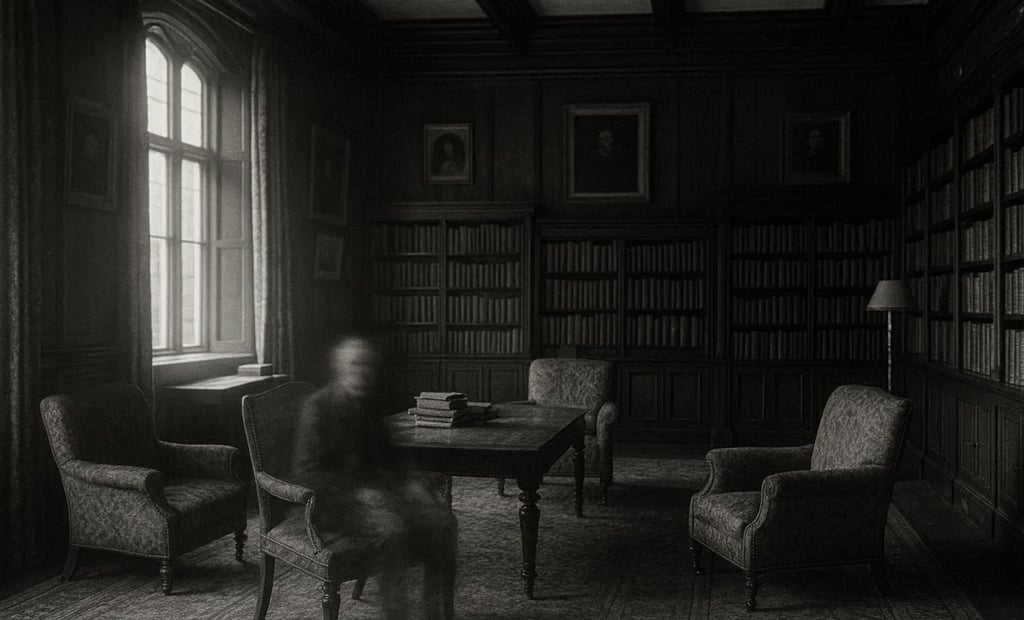
The Ghosts of Combermere Abbey (1891)
This photograph, taken in Cheshire, England, shows the empty library of Combermere Abbey. Or so it seems.
A blurred, seated figure appears in one of the chairs—transparent, indistinct, yet undeniably human.
At the time the photograph was taken, the abbey’s owner had recently died, and his funeral was reportedly taking place miles away. Staff claimed no one was inside the library during the long exposure.
Skeptics argue the figure could be a servant who briefly entered the frame. Paranormal researchers counter that the figure’s opacity and positioning do not align with typical motion blur.
Regardless of interpretation, the image remains one of the earliest alleged ghost photographs ever recorded.
The Brown Lady of Raynham Hall
Few photographs have haunted public imagination quite like the Brown Lady.
Taken in 1936 by photographers from Country Life magazine, the image shows a translucent figure descending a staircase at Raynham Hall, England. The figure appears draped in a flowing gown, with indistinct facial features and an ethereal glow.
The photographers were professionals with reputations to protect. The negative showed no signs of tampering.
The figure closely matched centuries-old descriptions of a ghost said to haunt the hall.
Whether one believes in ghosts or not, the photograph’s clarity and provenance make it difficult to dismiss outright.
The Battle of Los Angeles Photograph (1942)
During World War II, Los Angeles experienced what became known as the “Battle of Los Angeles”—a night of anti-aircraft fire aimed at an unidentified object in the sky.
A newspaper photograph captured multiple searchlights converging on a single point above the city.
The military later claimed the incident was a false alarm, possibly caused by weather balloons.
Yet the photograph shows a clearly defined object illuminated by dozens of beams.
To this day, no definitive explanation exists.
The Face on Mars (1976)
Captured by NASA’s Viking 1 orbiter, this image showed what appeared to be a massive human-like face carved into the Martian surface.
NASA initially dismissed it as a trick of light and shadow. Later high-resolution images revealed the formation to be natural.
Yet the original photograph sparked decades of speculation—and raised uncomfortable questions about how easily our minds perceive patterns where none should exist.
Or perhaps, how easily truth can be dismissed when it becomes inconvenient.
Why These Images Refuse to Die
What makes these photographs endure is not just their mystery—but their ambiguity.
They exist in the space between explanation and disbelief.
In many cases, rational explanations are plausible but incomplete. In others, no explanation fully satisfies all observed details.
Psychologically, humans are pattern-seeking creatures. We search for meaning, especially when confronted with anomalies. Photographs that appear impossible force us to confront the limits of perception, memory, and understanding.
They remind us that reality may be more complex—and less stable—than we assume.
Manipulation, Misinterpretation, or Something Else?
Modern technology has made photo manipulation commonplace. This has led many to dismiss all anomalous photographs as hoaxes by default.
Yet many of the images discussed here predate Photoshop, digital cameras, and even reliable film manipulation techniques.
This does not mean they depict the supernatural. But it does mean they deserve thoughtful examination rather than immediate dismissal.
History is full of phenomena once considered impossible—until science caught up.
The Thin Line Between Evidence and Mystery
Photography does not lie—but interpretation does.
Light behaves unpredictably. Human memory is flawed. Context is often lost.
Still, some images resist explanation even when every rational avenue has been explored.
And perhaps that is their true power.
They force us to sit with uncertainty.
Conclusion: When a Photograph Becomes a Question
These photographs are not proof of ghosts, time travelers, or extraterrestrials.
But they are proof of something else: that the world is capable of producing moments that challenge our assumptions.
They remind us that reality is not always as orderly as we would like to believe.
And sometimes, a photograph does not answer questions—it asks them.
Disclaimer
This article is intended for informational and entertainment purposes only. The photographs and cases discussed are presented based on historical records, eyewitness accounts, and publicly available documentation. Interpretations vary, and no claims are made regarding the definitive existence of paranormal, supernatural, or unexplained phenomena. Readers are encouraged to conduct their own research and form independent conclusions.
Check our other articles here.
The Jersey Devil: America's Creepiest Urban Legend of the Pine Barrens