
Written in Fear: The Most Chilling Unsolved Letters and Messages Ever Discovered
From cryptic death notes to anonymous confessions and coded warnings, explore the most chilling unsolved letters and messages ever discovered—documents that still haunt investigators and historians today.
MYSTERY
7 min read
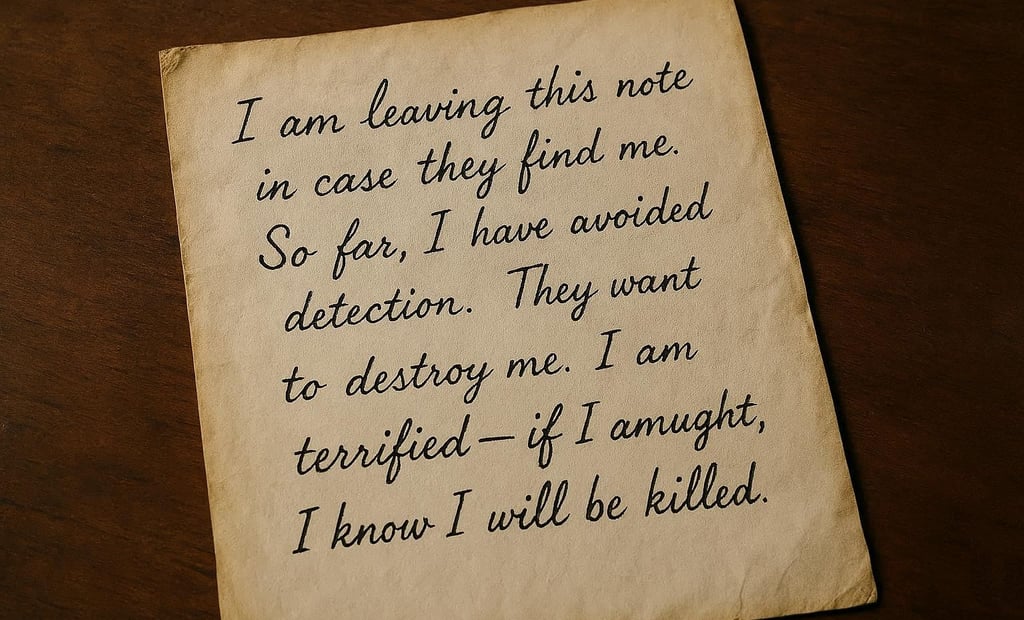
Written in Fear: The Most Chilling Unsolved Letters and Messages Ever Discovered
Words are meant to explain, to comfort, to inform. But sometimes, words do the opposite.
Sometimes, they unsettle us so deeply that decades—or even centuries—later, they continue to whisper fear into the present. These are not ordinary letters. They are fragments of human experience frozen in ink: pleas for help that arrived too late, confessions that named no culprit, warnings that no one fully understood until it was too late.
Throughout history, investigators, historians, and ordinary people have stumbled upon letters and messages that seem to open a door into something unresolved—something dark. These writings often appear without a clear sender, without context, or without an explanation that satisfies logic. Some were mailed. Some were hidden. Others were scrawled in desperation, found clutched in lifeless hands or buried in forgotten drawers.
What makes these messages truly chilling is not just their content—but the silence that followed them.
This is a documentary-style exploration of the most chilling unsolved letters and messages ever discovered. Each case is real. Each message exists. And in every instance, the truth behind the words remains just out of reach.
1. The Somerton Man’s Cryptic Code (Australia, 1948)
On a quiet Adelaide beach in December 1948, a man was found dead, neatly dressed, without identification. No signs of violence. No wallet. No cause of death that could be definitively determined.
But the most chilling discovery came months later.
Hidden in a secret pocket of the man’s trousers was a tiny rolled piece of paper bearing two words:
“Tamám Shud.”
The phrase, Persian for “It is finished,” was traced to the final page of a rare poetry book—The Rubaiyat of Omar Khayyam. Investigators later located the exact book missing that final page. Inside its back cover was something even more disturbing:
A handwritten code consisting of seemingly random letters arranged in lines. No punctuation. No explanation. Just letters.
For decades, cryptographers, intelligence agencies, and amateur codebreakers have attempted to decipher the message. Some believe it was a spy cipher. Others argue it was meaningless or personal shorthand.
Adding to the mystery, the book contained a phone number belonging to a woman who lived near where the body was found. She claimed not to know the man—but reportedly reacted with visible distress when shown a plaster cast of his face.
To this day, the letters remain unsolved.
And the message “Tamám Shud” lingers like a final, deliberate goodbye from someone whose identity—and intent—remains unknown.
2. The Zodiac Killer’s Letters (United States, 1969–1974)
Few cases demonstrate the psychological power of letters more clearly than the Zodiac Killer.
Beginning in the late 1960s, newspapers across California received taunting letters from an anonymous writer claiming responsibility for multiple murders. The letters were not merely confessions—they were threats, riddles, and challenges.
One letter famously included a cipher that the Zodiac demanded be printed on the newspaper’s front page. When cracked by amateur cryptographers, it revealed a chilling message asserting the killer’s belief in an afterlife where his victims would become his slaves.
But not all Zodiac ciphers have been solved.
Several remain partially or fully undeciphered, including one known as the 340 Cipher, which took more than 50 years to crack—and even then, raised new questions rather than answers.
What makes these letters especially unsettling is their tone. Calm. Mocking. Methodical.
The Zodiac seemed to understand that fear did not come only from violence—but from communication. From being heard. From forcing the public to read his words and wonder if he would strike again.
Despite modern DNA analysis and renewed investigations, the Zodiac’s true identity remains unknown.
And his unsolved messages still sit in evidence archives, daring someone to finally understand them.
3. The Circleville Letters (United States, 1976–1994)
For nearly two decades, residents of Circleville, Ohio, received anonymous letters that seemed to know far too much.
The letters accused individuals of infidelity, corruption, and dark secrets. They arrived at homes, workplaces, and even school buses. Some were crudely written. Others were precise and detailed.
One letter warned a school bus driver to stop an alleged affair—or face consequences. Shortly afterward, her husband died under suspicious circumstances involving a booby-trapped gun. The man had reportedly received threatening letters beforehand.
A suspect was eventually imprisoned, but the letters continued even while he was incarcerated.
One letter sent to the prison read:
“When we set them up, they stay set up.”
Handwriting analysis was inconclusive. DNA testing failed to produce definitive results. And no one was ever able to prove who authored the letters—or how they continued after the main suspect was locked away.
The fear wasn’t just in the accusations.
It was in the sense that someone was watching. Listening. Writing.
And never stopped.
4. The Black Dahlia’s Message to Police (United States, 1947)
The murder of Elizabeth Short—known as the Black Dahlia—is one of the most infamous unsolved crimes in American history. But amid the brutality of the crime, one element stands out as particularly chilling:
A letter sent directly to the Los Angeles Police Department.
The envelope contained Short’s personal belongings—her birth certificate, photographs, and social security card—carefully cleaned and arranged. The message was typed, mocking, and disturbingly casual.
It read, in part:
“Here is Dahlia’s belongings letter to follow.”
The sender promised more communication.
Additional letters followed, filled with taunts and false confessions. Some were later dismissed as hoaxes, but others remain under debate. Handwriting comparisons, linguistic analysis, and psychological profiling have never conclusively identified the author.
What makes the message terrifying is its intimacy. Whoever sent it had access to the victim’s personal effects—and felt comfortable enough to contact authorities directly.
The Black Dahlia case remains unsolved.
And the letters remain an eerie reminder that the killer may have wanted attention as much as silence.
5. The Lead Masks Notes (Brazil, 1966)
In a wooded area outside Rio de Janeiro, two men were found dead—lying side by side, wearing suits, waterproof coats, and homemade lead masks covering their eyes.
No signs of struggle. No visible injuries. No clear cause of death.
But nearby was a notebook containing a handwritten message, written like a checklist:
“16:30 be at agreed place
18:30 ingest capsules
After effect protect metals await signal mask”
Investigators were baffled.
What capsules? What signal? Why the masks?
No toxic substances were definitively identified, and no explanation has ever fully accounted for the scene. Some theorized experimental drugs. Others suggested cult activity. Some even proposed extraterrestrial contact.
The message itself offers no clarity—only implication.
It suggests intention. Preparation. Expectation.
And whatever the men were waiting for never came.
6. The “Dear Boss” Letter (United Kingdom, 1888)
During the height of the Jack the Ripper murders in London, a letter arrived at a Central News Agency office, addressed simply:
“Dear Boss.”
The writer claimed responsibility for the killings and mocked police efforts. He promised to continue murdering and suggested that future victims would be mutilated in specific ways.
Shortly after the letter was published, a victim was found with injuries matching the letter’s claims.
Another letter followed, accompanying part of a human kidney, allegedly taken from one of the victims.
While many historians believe the letters were hoaxes, others argue that certain details suggest insider knowledge.
The true authorship of the letters remains unknown.
But the psychological impact was immediate and devastating. The public panicked. Police resources were overwhelmed. Fear spread faster than facts.
Whether written by the killer or a cruel opportunist, the letters became part of the terror itself.
7. The Voynich Manuscript (Origin Unknown, 15th Century?)
Not all chilling messages are threatening.
Some are terrifying because they refuse to make sense at all.
The Voynich Manuscript is a handwritten book filled with unknown script, bizarre botanical drawings, astronomical charts, and symbols that resemble no known language.
Carbon dating places the parchment in the early 1400s. But no one knows who wrote it—or why.
Despite centuries of study by linguists, cryptographers, and intelligence agencies, the text remains undeciphered. The language follows statistical patterns consistent with real writing—but no translation exists.
Some believe it is an elaborate hoax. Others argue it may be a lost language or encrypted medical text.
What makes it chilling is the possibility that the manuscript was meant to be understood by someone—and that someone never came.
The message is intact.
The meaning is not.
8. The Hinterkaifeck Farm Note (Germany, 1922)
After six people were brutally murdered on a remote Bavarian farm, investigators made a disturbing discovery.
In the house was evidence that someone had been living there after the murders. Food had been eaten. Animals fed. Beds disturbed.
Even more unsettling was a note referencing strange sounds, footsteps in the attic, and an unknown presence—written before the murders occurred.
Despite extensive investigation, no suspect was ever conclusively identified. The killer vanished without a trace.
The note remains a chilling prelude—a written warning that something was already wrong.
And that someone was already there.
Why Unsolved Messages Haunt Us More Than Crimes
Murders can be reconstructed. Scenes analyzed. Evidence cataloged.
But words—especially unexplained ones—resist closure.
Unsolved letters and messages linger because they suggest unfinished communication. They imply intent without resolution. They create a relationship between sender and reader that never fully closes.
In marketing terms, they represent the ultimate “open loop”—a psychological phenomenon where unresolved narratives compel attention.
In human terms, they remind us that not all stories end with answers.
Conclusion: When Ink Becomes Evidence
Each letter in this collection represents more than a mystery. It represents a moment when someone reached out—whether in fear, arrogance, confusion, or calculation—and left behind words that still speak.
They are chilling not because of what they say, but because of what they refuse to explain.
And until they are understood, they remain what they have always been:
Messages from the unresolved past.
Disclaimer
This article is intended for educational and informational purposes only. All cases discussed are based on historical records, investigative reports, and publicly available information. Interpretations and theories mentioned do not constitute factual conclusions. This content does not accuse or implicate any individual and should not be considered legal, psychological, or investigative advice. Reader discretion is advised due to the sensitive nature of some topics.
Check our other articles here.